Innovation · E-mobility

Rethinking rotor shafts – without welding, with active cooling

Two ideas, one component
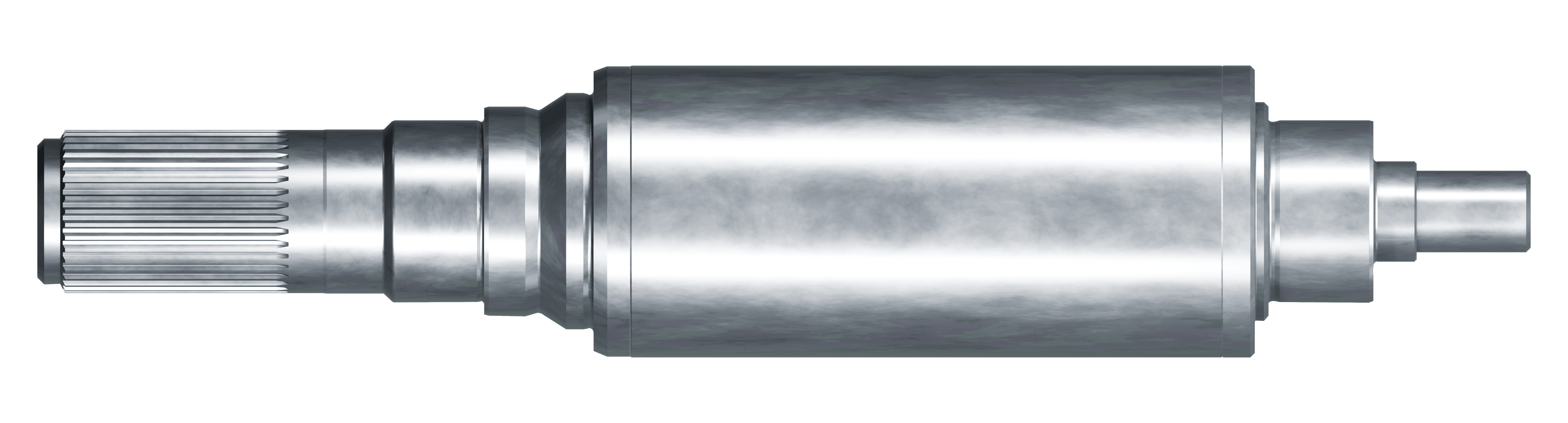
quick’nCOOL combines two innovations in the rotor shaft: “quick” – a modular assembly entirely without welding – and “COOL” – active rotor cooling that dissipates heat far more efficiently through guided flow channels. The result is a scalable, modular solution for high-performance e-motors.
Why rotor cooling makes the difference
The quick’nCOOL rotor shaft dissipates heat exactly where it is generated and complements proven stator cooling. This makes more of the performance potential of modern e-machines usable:
Dissipate heat precisely
Even at high power density, heat is efficiently removed directly at the rotor.
Stabilise magnet performance
Lower rotor temperatures protect permanent magnets and preserve their performance.
Reduce rotor losses
Targeted rotor cooling supports more efficient operation of the e-machine.
Complete the cooling system
Active rotor cooling complements stator cooling and makes better use of the machine’s performance potential.
Cooling in action
Assembly without welding
The plugs are precisely press-fitted into the shaft – eliminating welding. The modular design allows a wide range of variants and very short lead times.
- Press-fit instead of welding – even non-weldable material combinations
- Lower manufacturing complexity, cost-efficient up to high volumes
- Forging, milling, turning, grinding – anything is possible
- Internal features easy to integrate
- Short lead times through a modular building-block design
The clever cooling system
The strong cooling effect results from five characteristics that together increase heat transfer – and thus the efficiency of the motor:
- Size of the cooling surface (primary and secondary surfaces)
- Convection from the rotating coolant
- Integrated pumping effect from centrifugal forces
- Turbulence from the tooth/wave-shaped channel geometry
- Convection from the longitudinal flow
Backed by research
Together with RPTU Kaiserslautern the cooling concept was developed in a simulation-driven way (CFD). Of four shaft models, the guided-flow geometry achieves the best heat transfer per package volume – without a pressure penalty.
Minimum gain in heat transfer vs. the hollow shaft
Range of gains depending on speed
Possible reduction of rotor losses / copper usage
Possible added power (e.g. highway operation)
Source: CFD study by RPTU Kaiserslautern; values depend on operating point and machine design.